
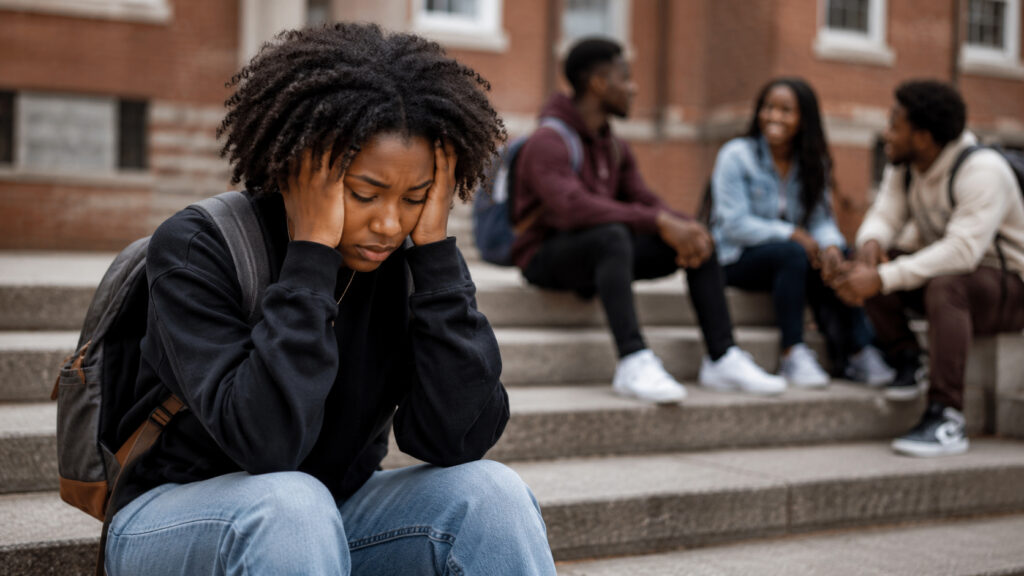
I have spent nearly two decades on the campus of Howard University. I have watched brilliant students arrive in the fall, electric with possibility, and I have watched some of those same students disappear by spring. Not dramatically. Quietly. A missed assignment becomes a missed class. A missed class becomes a leave of absence. A leave of absence becomes a statistic that no one names correctly.
We call it an attrition problem. A retention crisis. An academic persistence challenge. We convene task forces and redesign advising systems and restructure financial aid packages. And those things matter. But we are rarely willing to say the simple, uncomfortable thing out loud: a significant number of HBCU students are not leaving because they cannot do the work. They are leaving because they cannot carry the weight.
We are rarely willing to say the simple, uncomfortable thing out loud: a significant number of HBCU students are not leaving because they cannot do the work. They are leaving because they cannot carry the weight.
What the Data Actually Says
The numbers are not subtle. According to the Journal of Blacks in Higher Education, only 43.8 percent of Black students who entered a four-year college in 2018 had earned a degree from the same institution within six years, and at many HBCUs the average four-year graduation rate sits closer to 23 percent. Yet the crisis underneath those numbers is more specific than graduation statistics reveal.
A 2025 report published by The Steve Fund found that nearly 60 percent of HBCU students experience at least one mental health problem, 40 percent experience depression, and 32 percent report struggling with anxiety. Crucially, more than half of HBCU students, 54 percent, report unmet mental health needs, defined as exhibiting moderate to severe symptoms of anxiety or depression while receiving no mental health treatment in the past year. These are not marginal figures. They describe the emotional landscape that most HBCU students are navigating every single day, alongside coursework, finances, family obligations, and the particular psychological labor of existing in a country that has historically been indifferent to their flourishing.
Financial stress compounds everything. The same UNCF-Healthy Minds Network report found that 52 percent of HBCU students describe their financial situation as always or often stressful, a figure that interacts with mental health vulnerability in compounding, bidirectional ways.
The Complexity the Headlines Miss
It is worth being precise about what the research does and does not show. A landmark 2025 study conducted jointly by UNCF’s Institute for Capacity Building, the Healthy Minds Network, and The Steve Fund, examining 2,504 students across 16 HBCUs and two predominantly Black institutions during the 2022 through 2024 academic years, found that HBCU students demonstrate stronger sense of belonging and certain indicators of flourishing compared to Black students at predominantly white institutions. Forty-five percent of HBCU students reported flourishing mental health, compared to 38 percent of Black students at PWIs.
These findings do not contradict the crisis. They illuminate its texture. HBCU students are, in many ways, psychologically protected by the cultural belonging their institutions provide. And yet more than half still have unmet mental health needs. The institutions are doing something profoundly right, and the infrastructure to support the full range of student mental health is still profoundly inadequate. Both things are true simultaneously, and any honest solution has to reckon with both.
Why Existing Solutions Fall Short
Most mental health apps were not built for Black students. They were built for a general consumer market that defaults to white, middle-class, Western assumptions about what stress looks like, what help looks like, and what healing looks like. The American Psychological Association has formally noted that AI mental health tools trained on vast, unvetted internet data risk producing discriminatory or harmful advice for marginalized groups, and that biased outputs can be compounded by sycophantic engagement patterns that reinforce rather than challenge users’ existing beliefs.
Tacking a Black History Month campaign onto a generic wellness app does not make it culturally responsive. Cultural responsiveness is not an aesthetic. It is an architecture. It has to be built in from the foundation, or it does not exist at all.
What Culturally Responsive Support Actually Requires
In my thirty years of clinical practice, I have learned that culturally responsive care requires understanding the specific stressors that shape Black students’ inner lives: the pressure of being a first-generation college student carrying the hopes of an entire family; the weight of racial battle fatigue; the mistrust of mental health systems built on a history of pathologizing Blackness; the grief that many students carry silently because their communities have taught them that emotional vulnerability is a luxury they cannot afford.
Effective support requires tools that name these realities without pathologizing them, that are available at 2 a.m. when the anxiety hits, and that are designed with the specific texture of Black student experience at their core.
The Financial Case Is as Compelling as the Human One
Every student who leaves before graduation represents lost tuition, lost federal funding, and lost alumni giving across decades. Investing in mental health infrastructure is not a wellness initiative. It is an institutional survival strategy. For every ten students whose persistence is supported by genuine, culturally competent mental health tools, there are ten families who do not face the devastation of an incomplete degree. Ten communities who gain a credentialed professional rather than losing one.
Cultural responsiveness is not an aesthetic. It is an architecture. It has to be built in from the foundation, or it does not exist at all.
Kamilah M. Woodson, Ph.D., is a licensed clinical psychologist, tenured Full Professor at Howard University, Fulbright-Hays Fellow, and the Founder and CEO of Epiphany Psychological Solutions. She can be reached at info@epiphanypsy.com.
References
American Psychological Association. (2024). Health advisory: Use of generative AI chatbots and wellness applications for mental health. https://www.apa.org/topics/artificial-intelligence-machine-learning/health-advisory-chatbots-wellness-apps
Journal of Blacks in Higher Education. (2025, May). Ranking the nation’s largest HBCUs by their graduation rates. https://jbhe.com/2025/05/ranking-the-nations-largest-hbcus-by-their-graduation-rates/
The Steve Fund. (2025, May). Mental health crisis on HBCU campuses: New report from The Steve Fund calls for urgent action. https://stevefund.org/press-release/mental-health-crisis-on-hbcu-campuses/
UNCF Institute for Capacity Building, Healthy Minds Network, & The Steve Fund. (2025). Flourishing: Bolstering the mental health of students at HBCUs and PBIs. United Negro College Fund. https://uncf.org/news/new-research-by-uncf-and-healthy-minds-network-shows-strong-mental-health-outcomes-among-hbcu-students
Higher Education Today. (2025, April 14). The state of student mental health at HBCUs. American Association of Colleges and Universities. https://www.higheredtoday.org/2025/04/14/the-state-of-student-mental-health-at-hbcus/
U.S. News & World Report. (2025). 20 HBCUs with the highest four-year graduation rates. https://www.usnews.com/education/articles/hbcus-with-the-highest-four-year-graduation-rates